The Nine
On this page
The Nine
Two kilometres of cylinder, turning once every ninety seconds, forty thousand people, and nine doors meeting at the waist. More doors in one place than anywhere else in human space, because eight of them are simply Sirius’s nearest neighbours and the ninth is the Garden.
Everything in Act One happens here or one step off it.
How to run the hall
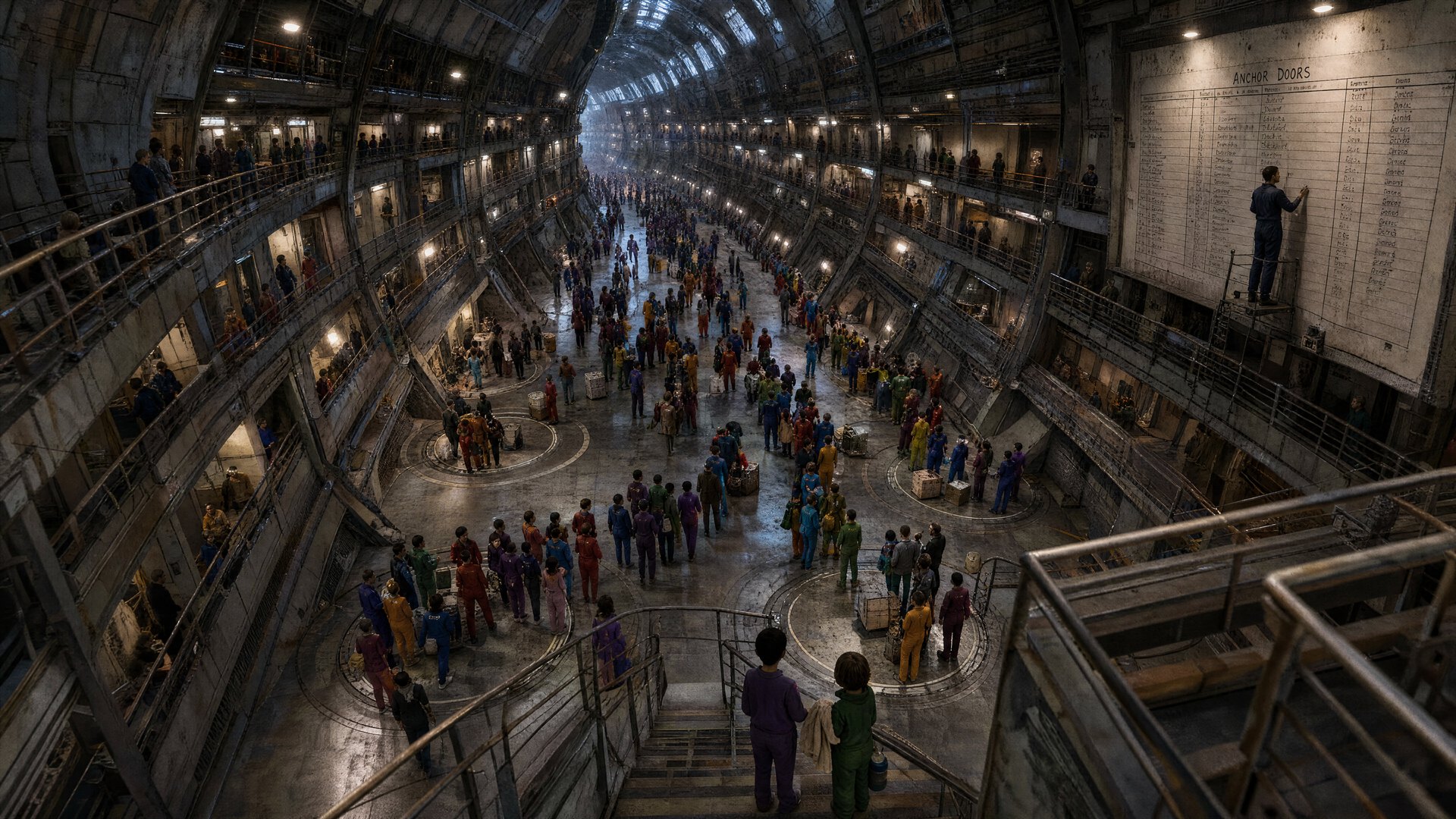
The anchor hall is the set. Get the player into it in the first ten minutes and keep coming back.
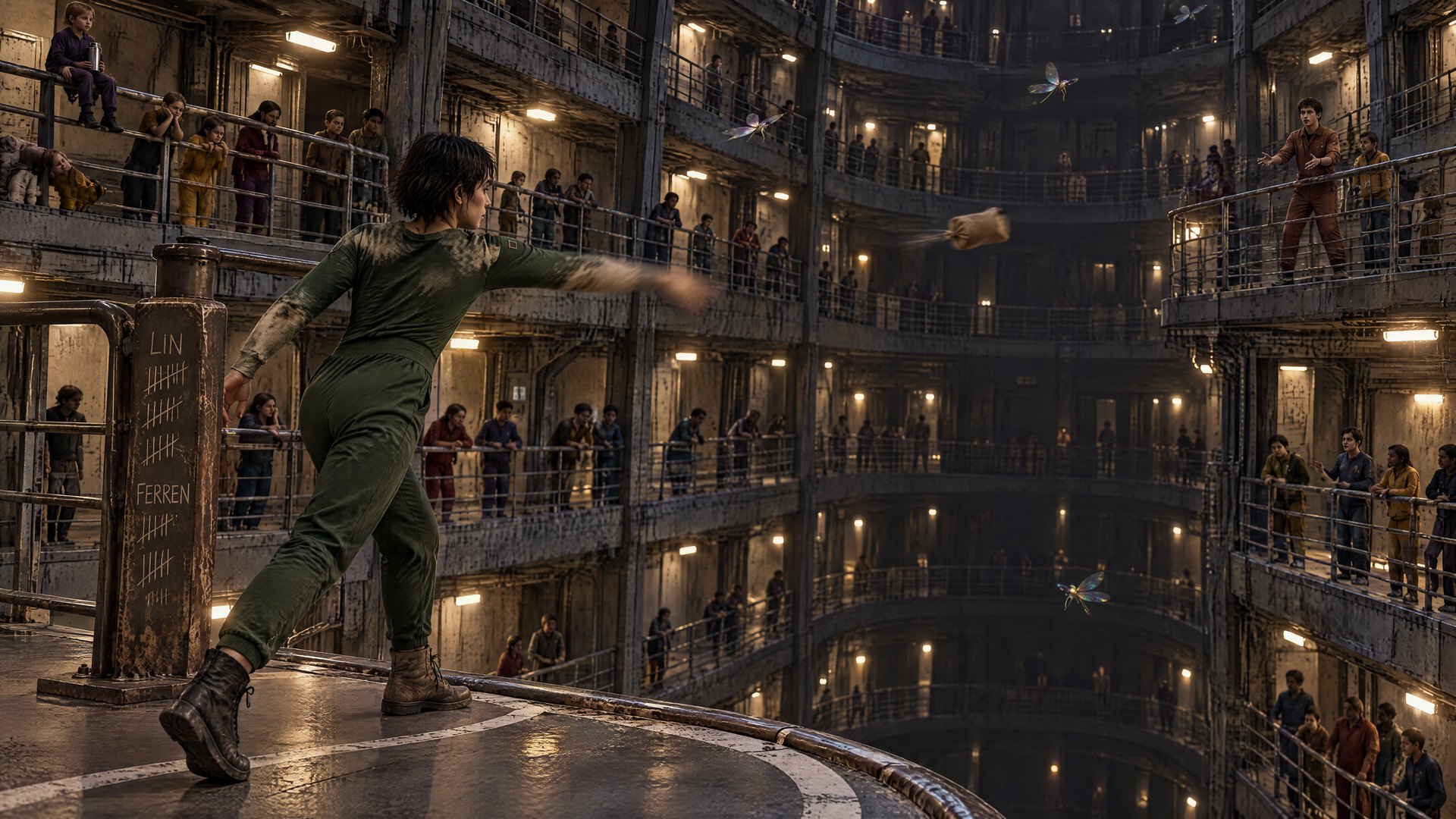
What makes it alive is procedure happening around somebody who is not part of it: nine queues, eight of them moving; a tallyman at the head of each with a board; a courier coming up out of a housing already peeling her weave off her forearms; two hall children at the bottom of a stair with a towel and a flask, because they know who is due.
The sound of the hall going quiet is the strongest tool you have in this building, and it is not a sound — it is about nine people stopping being loud at the same moment. Use it twice in Act One and no more.
Three details that do the work
The decks smell like their doors. The Procyon Stair is a suburb with prams on the walkway. The Coldwater Run is red light and grain dust and the only corner of the station that smells of farming. The Wolf Gate queue is shift workers, the roughest line in the hall, and the best food on the station.
The architecture is built for five peoples. Ramps where there should be stairs, a dim corner in every concourse, and duct grilles cut to scatter gauge on every deck — a mesh sized so a glint can pass and nothing larger can. There is a line in every budget argument about them and nobody has ever won it.
The Standing is four metres of board on the gallery wall with every door in human space on it, kept by an eleven-year-old on a stool. Four things on a line; people read two; the fourth is the watch and it is the only one that matters.
The entry on the station
Sirius, and the Nine
8.6 light years. The door is a little over eight hundred years old.
Sirius is two stars and no worlds. The big one is blue-white and far brighter than the Sun, close enough that every viewport on the station is filtered and the filters are checked twice a shift. The small one is a white dwarf — a dead star the size of a planet, the hottest thing within twenty light years, sitting there as a hard little point of light that children at the Nine are told not to stare at and do anyway.
Nothing orbits either of them that anybody has found. There is no ground here, no colony, no farm. There is only what people bolted together.
What people built here: the Nine.
Nine doors meet at this station, and that is the whole reason it matters. Eight of them go to Sirius’s own nearest neighbours — the dark drifter, Procyon, the sunless pair, the debris, the flare star, the first door ever opened, the refinery, and the long hop south. The ninth is the old direct route home to Sol.
Sol holds seven doors. Sirius holds nine, and all the traffic worth counting comes through here. That is the difference between the oldest place on the Causeway and the busiest one.
The station is a cylinder two kilometres long with the anchor hall at its centre, and the hall is the only room on the Causeway where you can stand still and watch people arrive from eight different stars in an hour. The Threshold keeps its ready room off the second gallery, with a window that looks down into the hall, because Calloway likes to see who is coming in before they know they have been seen.
What Sirius decided about minds
No grand position, and the Sirius authority is faintly proud of that. Two commitments, both out of the inquest into the Proper Order: personhood is granted, and the mind that runs the station is trusted. Neither is sentiment; both are findings.
Nobody here has wanted a new mind since the Reach. See Old Man Sirius and The Causeway and its Minds.
Life on it
Life at the Nine
8.6 light years. Two stars, no worlds, and every stone of it carried here.
The Nine is a cylinder a little over two kilometres long, turning once every ninety seconds, with the anchor hall at its waist where the spin is gentlest. Forty thousand people live in it. Nothing grows outside, nothing is mined here, and there is no ground within eight light years in any direction.
Sirius comes through every port as a hard blue-white that the filters never quite tame, so the Nine runs on shutters: the outer decks are shuttered by default and opening one is a small occasion. The white dwarf is a separate, meaner point, and children are told not to look at it and all look at it.
The hall
Nine housings set in a ring in the deck, each four metres across, each with its own queue and its own smell coming off it — cold rock, wet grain, hot metal, ozone, the sharp green of the Coldwater runs.
It never closes. There is no hour at which the hall is empty, and the sound of it — nine queues, nine tallymen, nine different accents and the fetches of five peoples all talking at once — is the first thing a visitor notices and the last thing they stop hearing.
Over the hall, on the gallery wall, is the Standing: a board four metres wide on which every door in human space is written up with where it currently goes. It is updated whenever a courier comes in with better information. It is the single most important object in the Causeway and it is written by hand, because a line can be corrected in eleven seconds by somebody standing on a stool — and because Old Man Sirius is not permitted to write on it. A door’s far side is courier testimony, and a mind may not enter testimony it does not have.
People stop under it without meaning to. Arguments start there. The Threshold’s ready room has a window onto it.
The Old Man
Forty thousand people live inside Old Man Sirius and almost none of them think about it, in the way you do not think about a floor. He runs the air, the water, the spin, the trim, the exchangers, the lamps and the growing decks, and he has done it for nine hundred and seventy-five years.
He talks to everybody, in a voice built for them, and people compare notes about it endlessly and can never settle anything, because nobody can check what he said to somebody else. The Old Man told me is the most-used sentence on the station and the least verifiable.
He will not decide anything for you. Ask him a question as a question and he answers it completely; do not ask, and he will ask how you are instead.
Where people live
The decks are named for the doors, and a door’s neighbourhood takes on the character of the place it leads.
- The Procyon Stair — five light years and the shortest hop in the network, so it is practically a suburb. Day traffic. Families.
- The Coldwater Run — grain, red light on the crates, the only place at the Nine that smells of farming.
- The Wolf Gate — flare-star traffic, shift workers, the roughest queue and the best food.
- The Cold Doors — WISE and Luhman 16. Quiet, dim, and where the fathoms are.
- The Old Line — Alpha Centauri. Oldest fittings in the station, and the families who hold the berths there have held them for six hundred years and mention it.
What it is like
The air is recycled past the point of opinion and everybody has a view on which deck’s is worst. Water is counted. Food is mostly from the growing decks at the ends of the cylinder, where the spin is heaviest and the work is hard, plus whatever comes through the Coldwater run, which is why grain is a luxury you can smell on people’s coats.
The architecture is built for five peoples. Galleries left open overhead because fathoms will not use a corridor. Ramps where there should be stairs. A dim corner in every concourse. Duct grilles at scatter gauge, and a line in every budget argument about them.
Nobody at the Nine is from the Nine, exactly, and everybody at the Nine is from the Nine. It is a port. The accent is nine accents. The food is argued about on principle. Half the adults in the station arrived as children and cannot now leave, and the other half were born here and never could.
The thing visitors are shown
On a clear watch, when the shutters on the upper gallery are open, somebody will take you up and point out a dim star and tell you that is Kapteyn’s.
Then they will tell you about The Nine Hundred Years, and watch your face, because everybody at the Nine has had it done to them once and nobody misses the chance to pass it on.