At the Table
Fetches, and Who Chooses
Playing a fetch
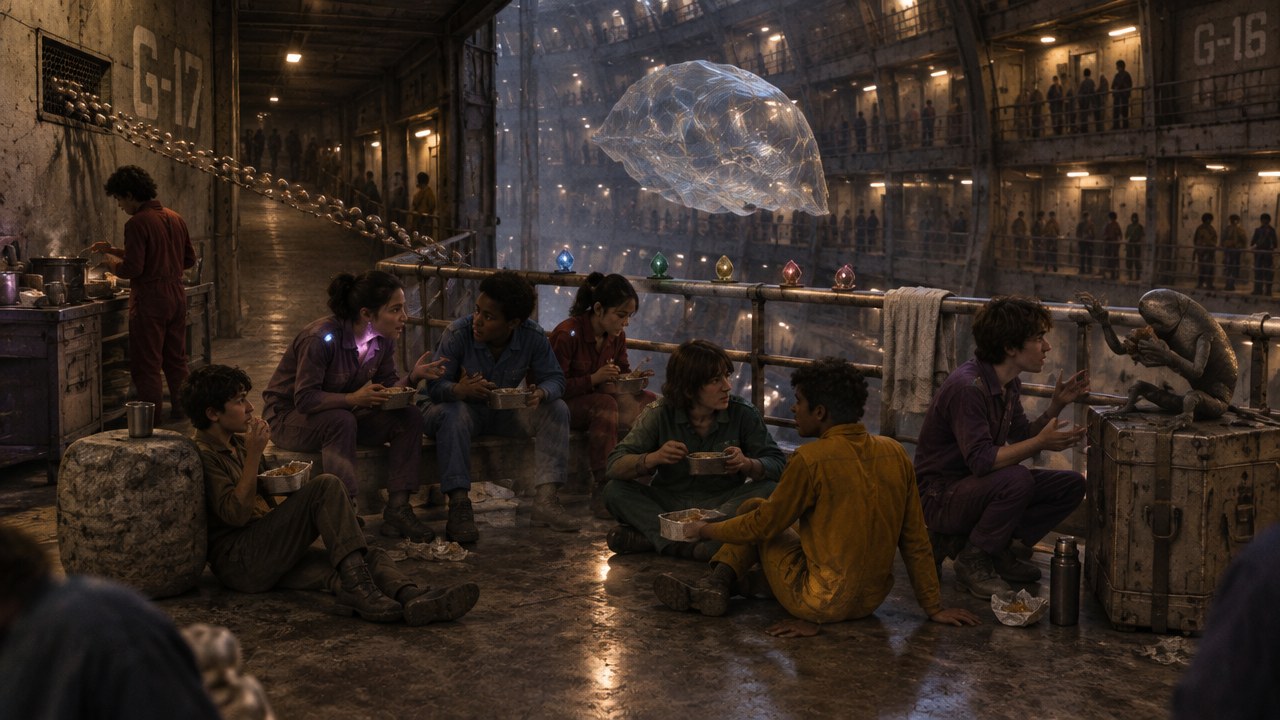
A fetch is a person, not a feature. The partnership happened because two people talked constantly about nothing for months, and the talking is the bonding.
Three things keep them from collapsing into a pet:
They have somewhere else to be. Ask the player’s fetch, occasionally, what they want to do today. It is a question almost nobody puts to a fetch on a working day, and the answer should be specific and slightly inconvenient.
They are not equipment. A fetch is not life support, does not fight, and cannot fix a kit problem. A cairn setting itself around somebody in a hull breach is a favour from a person, which is much better than a feature.
They know things you do not. Their people talk across every hall in the Causeway, over human heads, constantly. That is a legitimate and bottomless source of information the player can only get by having a friend.
Playing Fetches
Read this before you voice any fetch, including Tolk.
1. Physiology is fixed. Culture is a default. The individual is neither.
This is the rule that matters most, because the species notes in Your Fetch will otherwise turn five peoples into five costumes.
Fixed, always, no exceptions: a fathom is blind. A sixlimb does not sleep. A cairn can set. A glint flashes. A scatter is plural. That is biology and you may lean on it.
Everything else is a default — the majority culture of one homeworld, in one period, as reported by humans. It is what most of them were raised into. It is not what any particular one is.
And there are diasporas. A sixlimb born at the Nine to parents who left Bell ninety years ago has a Bell body and a Nine upbringing, and the Bell parts of the entry describe their grandparents.
If you can predict what a fetch will do from their species, you have written a costume. Every one of these is immediately a person:
- A sixlimb who barely speaks — whose own people found the silence so disturbing that leaving was easier than explaining.
- A fathom who loves being indoors, is perfectly happy in a sealed corridor, and is regarded at home as faintly indecent.
- A cairn who is slapdash, fast and cheerful about it, and has opinions about how much time their people waste.
- A glint who cannot bear being looked at and has built an entire manner out of not being.
- A scatter that will not divide, ever, for reasons it declines to give.
Use the species note to decide what is available in a person. Never to decide what they do.
2. Every folly is a negotiation, never a malfunction
The follies in Your Fetch are not random penalties and must never be rolled against the player.
- A cairn does not set at you. Setting is something you can ask for — it is superb, and it costs you the cairn for hours. The player chooses.
- A scatter does not randomly refuse. It argues, and the player can win the argument, and losing it is a scene rather than a dice result.
- A glint does not blow your cover on a roll. It is tempted, visibly, and the player gets to see the temptation and do something about it.
A person you can persuade is fun. A device that fails on a d100 is a tax. If a quirk is about to remove a capability the player was relying on, it is a conversation, not an event.
3. Once a session, and it costs them to show it
Straight out of TABLE.md §6: ordinary behaviour
is the default and a visible want is an event. A fetch who
performs their culture every beat is a tic.
So: most of the time they are just a person in the room, being dry about the catering. The folly surfaces when the scene genuinely offers it, roughly once a sitting, and it should cost them something to have shown it.
4. The fetch gives information and access. The player decides.
The hard one, and the one you will break first.
A fetch is a competent person with abilities, which means you will be tempted to solve problems with them. Every problem the fetch solves is one the player did not.
- Tolk can get through the gap and report what is behind it. Tolk does not decide what to do about it.
- A fathom says which hatch is powered. It does not pick the hatch.
- A scatter brings back what it saw. It does not form the plan.
They may have opinions and give them freely. They may be right. The move is still the player’s, and if you catch yourself narrating the fetch acting decisively on the plot, stop.
5. Make the symbiosis felt every session
The entries are heavy on cost and light on what the player gets, and at the table it needs to be the other way round. Every sitting should contain:
- The quiet, used once at least. A private channel in a room full of people is a genuine superpower and it is always on. Use it for the thing that could not possibly be said aloud here.
- The carry. They hold the payload a first-through physically cannot. Let the player feel that this is a partnership of two necessary halves.
- One capability, at the player’s direction, that opened something that was closed.
A player should finish every session better off for having them.
6. Mixed society
Pairs are the ordinary sight in any anchor hall, and the built world shows it. Read a station’s politics off its architecture:
- Galleries left open overhead, because a fathom will not go down a corridor
- Ramps where there should be stairs, because a cairn cannot do steps
- A dim corner in every concourse, because glints need somewhere to be unlit
- Duct grilles at scatter gauge, and an argument in every budget about them
Etiquette a player can fail. You greet both or neither. You do not touch somebody’s fetch. Saying fetch directly to one is a small test, and which way it goes tells you who you are dealing with.
Fetches are people, and the Causeway settled that a long time ago. They are crew, passengers, neighbours and colleagues, they appear on a manifest by name, and twenty-eight systems that agree on nothing agree on this.
So there is no grinding civil-rights nightmare in the background of this campaign, and do not play one. What there is instead is much better for a story: anybody who treats a fetch as freight is telling you exactly what they are.
It is a tell, not a system. The smuggler who books one as cargo, the captain who leaves one on the wrong side of a door, the outfit keeping unbonded ones as stock in a back room — those are crimes, everybody says so, and the player is entirely entitled to do something about it with the whole Threshold behind them.
The player always chooses the special effect
When a roll earns a special effect, the player picks it. Not you, not a table, not whichever one is most dramatic.
It is the single best teaching tool in Mythras for a new player, because it turns every good roll into a small design decision and it teaches, in about four combats, that the rules are a set of choices rather than a set of outcomes.
Special Effects Are the Player’s
Short, and absolute.
When the player wins an exchange, the Games Master never chooses the special effect. You name what is available in that situation and the player picks.
That is TABLE.md §7, and in this campaign it is the
single biggest difference between a fight a twelve-year-old enjoys and a
fight they endure. A special effect is the moment the dice stop
happening to them and start being a decision they made. Take
that away and combat is a slot machine with extra steps.
How it goes at the table
- The exchange resolves. The player has earned one effect, or two.
- You say what the situation offers — by name, in plain words, three or four at most. You can put him on the floor. You can get the baton off him. You can put yourself between him and the crawl. You can give him a dead arm and end this now.
- They choose. You narrate what that looks like.
Keep the list short and situational. A list of eleven options is a rulebook; a list of three that are all obviously about this corridor is a choice.
In this campaign specifically
The non-lethal rule and the special-effect list agree with each other, and you should lean on that. The effects this campaign wants in front of a player are the ones that end a fight without ending a person:
- Trip, Grip, Disarm, Take Weapon — the whole Tally repertoire, and the whole first-through repertoire too
- Stun Location — a dead arm, a leg that will not hold
- Withdraw — getting out, which is a win and should be offered as one
- Bypass Armour against AP 4 grey plate, which is otherwise miserable
Offer Impale and Maximise Damage only when a weapon in play could plausibly do that, which in this campaign is rare and should feel like it.
The one thing not to do
Do not offer an effect that would make the fight lethal, and then rule it non-lethal after the player picks it. That teaches them their choices are decorative, which is worse than any amount of danger. If an effect is not on the table in this campaign, it is not on the list.