Act One
On this page
The Turn, and the Relay
Act One has one hinge and everything before it exists to set it up.
The turn
The player will arrive at the crisis believing the question is how many carries can I make before it kills me? — because that is the arithmetic a first-through is trained in, and because every adult in the hall has just been careful to tell them the honest cost.
The answer to that question is four, and four is not enough, and the player will know it.
The actual answer is the one nobody says out loud:
How many of you are there?
Four hundred and six. The question is not how much one child can spend. It is whether one child can stand in a hall and ask four hundred of them to each spend a little.
The player must reach that themselves. Do not offer it. Do not hint. Do not have a Non-Player Character arrive at it one beat early to be helpful. If they are stuck, make the hall more crowded, not more talkative — let them see four hundred first-throughs, on stairs, on gallery rails, in the queue behind them.
When they say it, give it to them completely and immediately. Calloway does not debate it. She turns round and starts assigning.
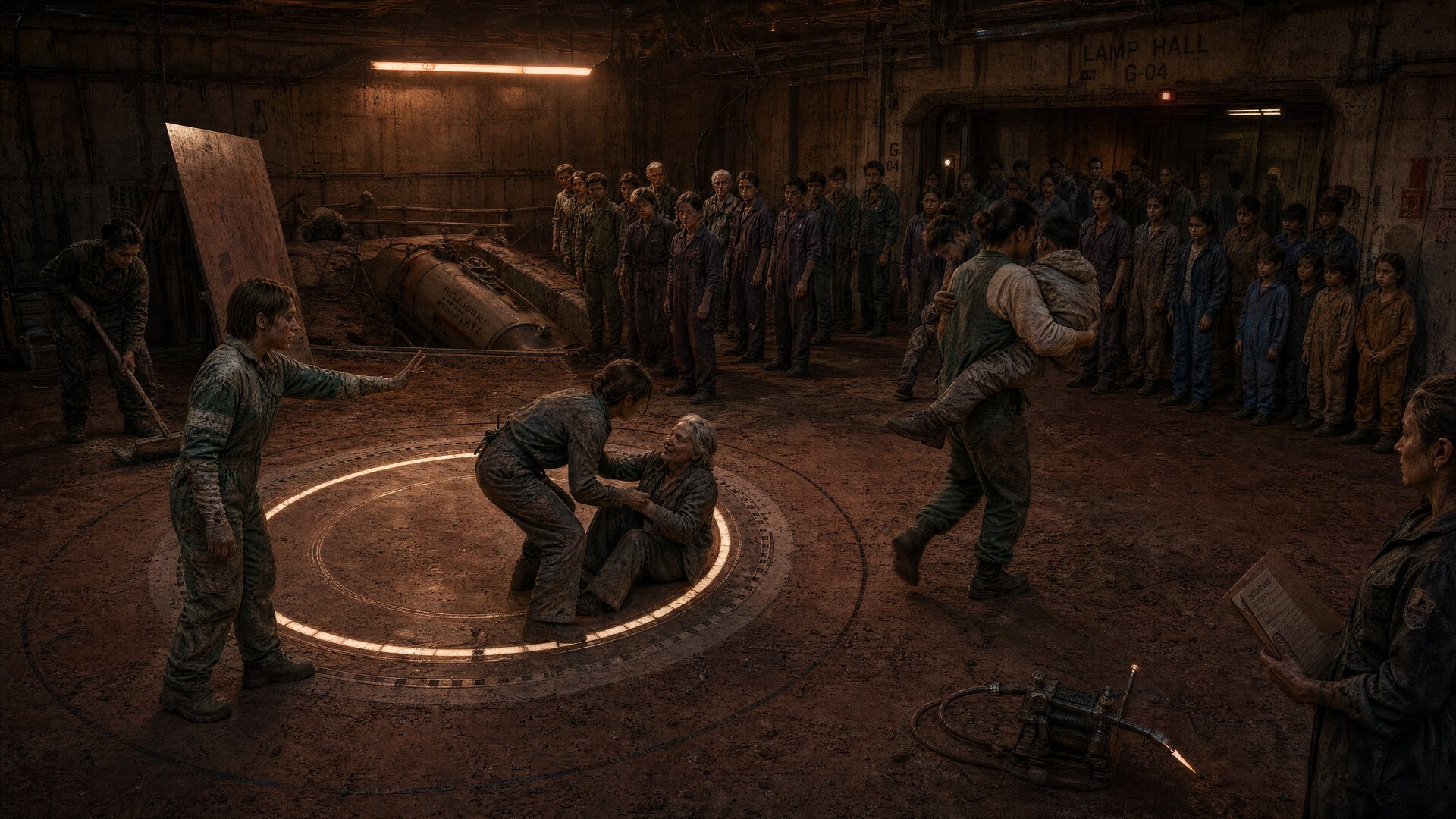
What the relay actually is
A clock, not a rule. They can get everybody. Nothing is holding a quota against them. What they are racing is a number that rises every time somebody crosses, and the cost lands on four hundred named people who each said yes.
Run it as alternating texture:
- The arithmetic, said out loud by whoever has the sheet. Ninety seconds a crossing, sixty-one people, and the number is climbing.
- One carry in close, in detail, with a name on the person being carried.
- One thing going wrong that is nobody’s fault.
- Somebody doing the wrong thing for money, in public, while it is happening, and nobody saying anything about it.
Then the number again.
Do not let it become a committee
The failure mode of this act is a room of competent adults solving it while the player watches. The guard is mechanical: if nobody has rolled anything in two exchanges, the scene has stopped. Put something in front of the player that only hands can fix.
The cost
Whatever happens, the act takes: a few days each off four hundred named lives, freely given, because the player stood in a hall and asked for them — and whoever was still on the far side when the mouth settled, which is an order somebody chose under a clock nobody could read.
Say the cost plainly afterwards. Do not soften it and do not make it tragic. They won, and the price was real, and both of those are the point.