The World
On this page
The Five Peoples, and Your Fetch
Four of the twenty-eight systems had somebody already in them. A fifth turned up later. None of them are humanoid, none of them are hostile, and all five of them cross doors free, because nobody has ever found a way to charge them and the attempt has been made.
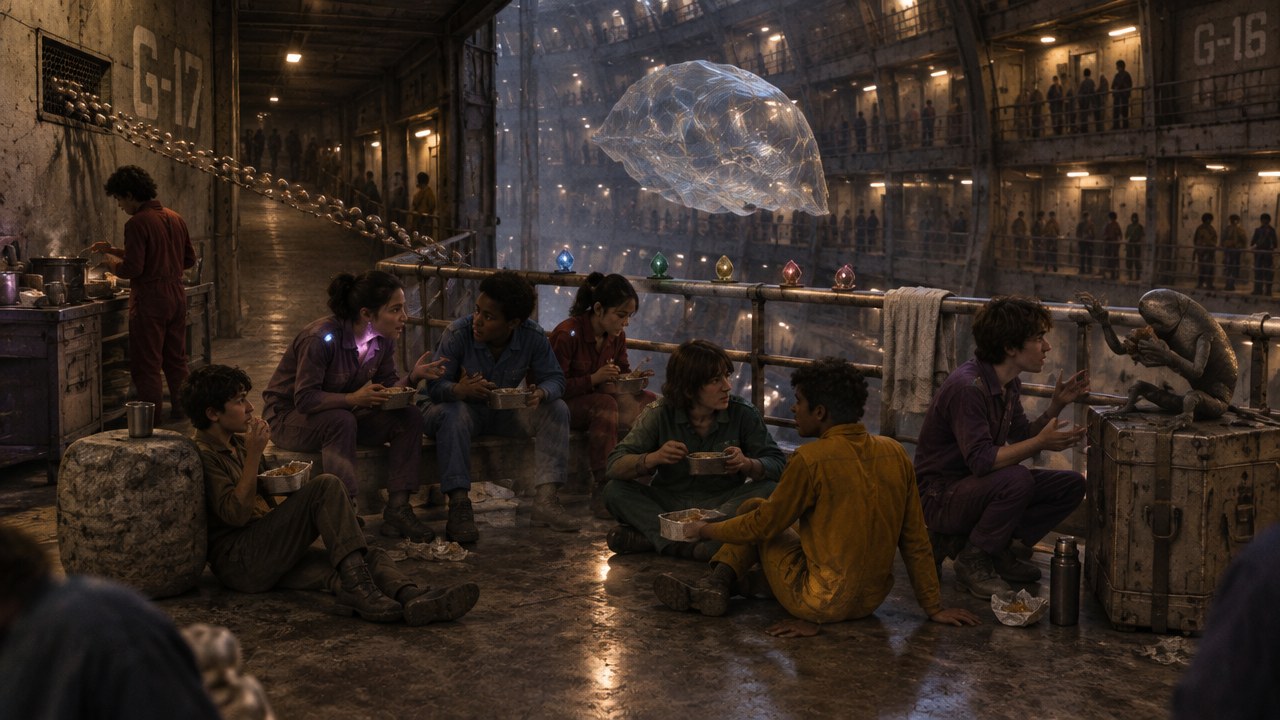
Sixlimbs, behind the TRAPPIST-1 door. Fathoms, from the cloud decks of Luhman 16 — eyeless, unsupported, and they read a room by what its fields are doing rather than by looking at it. Cairns, out of the shelters of Tau Ceti, who go mineral-rigid in four seconds and are immovable for hours. Glints, from the flare twins at Gliese 65 — hand-sized, faceted, built to shed energy, who talk in overlapping pulses of colour at a speed no mouth can manage. Scatters, from the belts of Epsilon Eridani, who are hard-vacuum tolerant and can send a third of themselves somewhere you cannot go.
Your fetch
A fetch is one of them who has decided to work with you.
Not a pet, not equipment, not a familiar, and emphatically not a feature of your character sheet that you spend points on. A person, with their own culture, their own opinions about your decisions, and somewhere else they could be. They cross with you because they want to. They can stop wanting to.
The partnership is not formal and nobody signs anything. What happens is that you talk — constantly, for months, about nothing — and at some point it is a partnership and neither of you can say which week it became one.
They will not fight for you, they are not your life support, and if you are walking into vacuum in the wrong skin your fetch cannot fix that. What they can do is be somewhere you are not, notice something you cannot notice, tell you the truth when nobody else in the room will, and be extremely pleased to see you.
A glint on your collarbone will also be insufferable in front of strangers, and that is the single most reliable fact in this setting.
And they are better connected than you are
Worth knowing, because it changes how you play.
Your fetch has their own people in every hall on the Causeway, and they talk to each other constantly, over your head, in a language almost no human can read. A glint knows what happened at Procyon this morning. You do not.
They also carry for free, and nobody searches them, and a species whose tissue can hold data is a species that every government in human space has at some point had a quiet think about.
Which makes you, specifically, the weak link in a great many plots. Nobody has ever got anything out of a fetch by asking. Several people have tried getting it out of the human.
The full reference
Your Fetch
You do not get a fetch. A fetch happens to you, usually within a year of the hall test, and after that you are two.
The Threshold’s paperwork calls them seconds, which is accurate, dignified, and not a word anybody has ever said out loud to a twelve-year-old holding one.
What they are
Five species that anybody has found, on five worlds with nothing in common, and every one of them does the thing described in What Crosses Easily: their cells take what is written into them and keep it, perfectly, for a lifetime.
Where a first-through carries, a fetch keeps. Neither can do the other’s half. A fetch cannot cross a door without you and you cannot hold a payload without them, and nobody has the faintest idea why the universe has arranged itself into halves that fit.
The xenobiologists call it the correspondence. The standing paper is two pages and the second page is questions.
The talking is the bonding
This is the part people get wrong, and it matters.
A fetch does not talk because it is clever. It talks because it is bonding, and language is what the bond is made of — attention, back and forth, every day, for years. The grammar arrives with the bond. The jokes arrive a bit later.
Which is why a book does not speak. A book is one of these creatures that nobody ever bonded with: kept as stock, fed, warm, written to by strangers, handed over at the far end. It has never been anyone’s. There is nothing wrong with it and nothing was done to it.
First-throughs do not like being in the room with the stock. They are not able to say why in a way that satisfies a reader, and readers have stopped asking.
The bond is not a leash. Your fetch argues, refuses, wanders off and takes an interest in things you do not. They can be furious with you. The one thing they cannot do is be comfortable on the far side of a door from you, and neither can you, and that is as near to physical as anything in this gets.
The quiet
Talking aloud is how the bond is built. It is not how an old bond runs.
Somewhere after the first few years the words stop needing to be said, and a pair starts going quiet — which is the most misleading name anybody could have chosen for it, because what it actually is is two people never shutting up and nobody else hearing a word.
It arrives on its own, in stages, and every first-through can tell you roughly where they are on it:
- First year. Feeling only. You know when they are frightened, or delighted, or have found something. No detail, and it wakes you up.
- A few years in. Direction, images, yes and no. Enough to be told that way and not that way and there are three of them.
- Mature, five years and up. Words. And, close to, a thin borrowing of their senses — what a kite can see from up there, dimly, as if remembering it rather than looking.
You cannot lie in it. You can refuse to say a thing, and everybody learns how, and both of you always know a refusal is happening. First-throughs find ordinary human conversation a bit slack afterwards.
What it will not do
- Only your own fetch. Never another person, never somebody else’s fetch, never two pairs chaining it. A great many people have tried.
- A few hundred metres. Less through rock or plate. It thins out rather than cutting off, so you can feel the edge of it coming and most people hate that.
- It is tiring. A long exchange at the far edge of the range costs you a day.
- And it does not cross a door. Ever.
That last one is not a technicality. Every first-through describes the crossing the same way: your fetch goes out, and there is a moment with nothing in it, and then they come back. Some of them talk about that moment for the rest of their lives.
Go through without them and you arrive into a silence that does not thin out and does not come back until you return. People do it when they must. Nobody does it twice in a row.
The five peoples
They are not companions. They are five sentient species who cannot cross a door without us, and we cannot hold a payload without them, and everything else about the arrangement has been negotiated over nine hundred years by people with their own reasons for showing up.
Each of them has a culture, a language, a sense of humour, and a characteristic way of being insufferable.
Sixlimbs — Bell, behind the TRAPPIST-1 door
Cat-sized, six limbs, four of them hands. Bell’s sun has not moved in four billion years, so they have no day, no night, and do not sleep at all, ever, and they will sit up watching you do it and raise it the next morning.
Everything in a sixlimb culture is conversation. Decisions are made by talking until everyone is too tired to object, privacy is a concept they can define and have never felt, and in a wind that never stops a group stays together by voice — so a sixlimb who has gone quiet is a sixlimb in trouble.
They want: everywhere. The most ambitious diaspora of the five, by a long way, and a sixlimb partnering with you has already worked out the four systems you might plausibly get them to.
Their folly: they hold grudges about arguments. Not injuries — arguments, eleven years old, which they can quote. And because silence reads to them as deceit, they distrust quiet people on principle, which is wrong about nine times in ten and catastrophic the tenth.
Fathoms — the cloud decks of Luhman 16
A metre of membrane and gas, almost weightless, from a sky with no ground and no sun in it. Blind, and the concept does not interest them. They feel electrical fields and sound instead, and map a room by charge the way you map one by eye.
Their art is entirely sound and current. Human visual culture strikes them as a charming party trick that we have unaccountably built a civilisation on.
They want: other skies. A fathom goes out to feel weather that is not the weather they were born in, and most of them are quietly looking for one specific thing they will not describe.
And one of them matters enormously and nobody has noticed. A fathom maps a room by what the field in it is doing, which means a fathom standing at a housing can feel whether the mouth is pinned or slipping — directly, without instruments, from the rim. It is the only sense in human space that reads a stray coming, and the five peoples have been carrying it around for nine hundred years while humans timed things with their own heartbeats. See The Hesitation.
Their folly: insufferable snobs about music, and will tell you so, in front of the musician. And being indoors makes them stupid and miserable, which they deny absolutely while making a run of terrible decisions.
Cairns — the shelters of Tau Ceti
Low, dense, unhurried, about the mass of a full toolbag. Seven hundred thousand years of things falling out of the sky have made them patient in a way that is hard to be in a room with.
They build. Everything is ceremony and workmanship and the long view, and a cairn can tell you who made a wall, roughly when, and what they were worried about.
At need they set — mineral-rigid in four seconds, immovable for hours. Nothing hurts them. Nothing wakes them either.
They want: methods. A cairn travels to see how other people build and carries it home, and they regard this as the only serious reason to go anywhere.
Their folly: appalling snobbery about workmanship, delivered to your face, at length, in front of whoever built the thing. And they set involuntarily when badly frightened — then spend hours as a rock, and afterwards lie about why.
Glints — the flare twins at Gliese 65
Small enough to close a hand around, from a system whose two stars try to kill everything several times a day. They shed radiation by going mirror-bright to absolute black in an instant, and their language is light.
Speech is their second language and they are not especially good at it. Flashing is their first, and it is theatrical by grammar — emphasis, exaggeration and flourish are built into the structure rather than chosen.
They want: an audience. Glints go out to be seen, and are entirely open about it, and find human embarrassment about ambition baffling.
Their folly: they exaggerate constantly and do not experience it as lying, because in their own language nobody would be deceived. They will also upstage you at the exact moment you least need it, and apologise, and do it again.
Scatters — the belts of Epsilon Eridani
Not one animal. Forty-odd small units moving as one thing, hard-vacuum tolerant, able to come apart on purpose and send a third of themselves somewhere you cannot go.
A scatter is a committee. They have no singular pronoun for themselves in any of their languages, and the idea of a single indivisible mind strikes them as a terrifying disability that they are too polite to mention more than once a week.
They want: to grow. More units, more reach, and anywhere with the materials to manage it.
Their folly: they vote. On everything, including whether to help you, and the vote can go against you with no appeal. Divided they are slower and stupider and know it, and divide anyway, and a scatter that has split too often starts quietly forgetting things and blaming you for the gaps.
And they cross for free
You have to be held through a door. A fetch does not — they are the complementary half of what the door does, and they cross in the wake of the opening at no cost to you whatever.
Which means your fetch is not luggage and is not dependent on you in the way it first appears. They are the only kind of person in human space who can move freely, they have relatives and interests in four systems, and the five peoples between them are far better informed than any human government. See Carrying.
They still cannot open a door. That is the half they need you for, and it is the whole basis of the arrangement — but do not mistake it for helplessness, and do not be surprised when yours turns out to have known something for a fortnight.
Partnering
You do not choose a fetch off a list and they do not choose you for your qualities. Mostly it is proximity and need: they are going somewhere, you can get them there, and the two of you turn out to be able to stand each other.
The Yards at 61 Cygni are the only place all five peoples are under one roof, so Threshold intakes come out paired in combinations that would never have happened anywhere else, and spend their careers explaining them.
And it is not for life. Partnerships form, hold, drift and end, the way anything between two people does. A fetch whose route has dried up will go with somebody whose route has not, and say so, and be right to. You can be left. You can be the one who leaves, and have to look at them while you say it.
The quiet goes with the partnership. It takes years to build, it is the best thing either of you has, and when you part it fades inside a year — which everybody knows going in and nobody really believes until it happens.
A note on the word
“Fetch” is ours, not theirs, and it is mildly rude. Every one of the five peoples has its own name for itself: the sixlimbs’ translates roughly as the ones who are talking, the cairns’ as those who wait, and a glint’s is a flash-pattern that does not survive being written down. Scatters have no singular form at all.
The Threshold’s paperwork says second. Some fetches find fetch affectionate. Some find it precisely as patronising as it sounds, and will tell you which camp they are in about four minutes after meeting you.