The City
On this page
The City on the Water
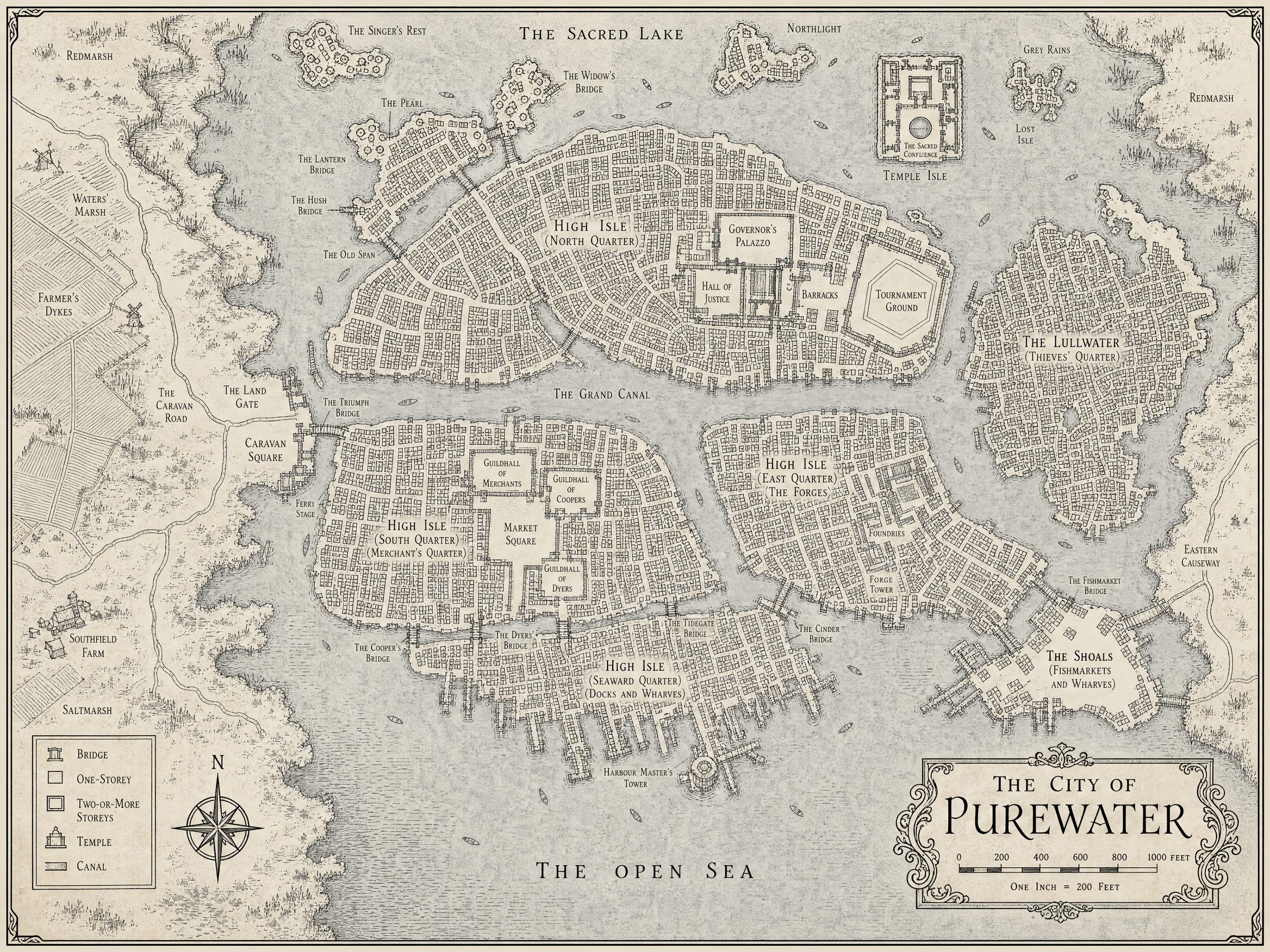
Purewater is built across the Mouth, the narrow strait where a great sacred lake to the north drains into the open sea to the south. It is rich, strategic and rotten, and its own people call it Pisswater, for the smell of the canals and for the smell of its politics.
The City Has No Ground
Purewater is built on water and does not apologise for it. Houses come straight up out of the channels with no bank and no shore, and their doors open onto steps that go down under the surface and keep going. Between the buildings there are ledges a body or two wide with no rail, and bridges, and water.
Everything that matters goes by boat, poled, rowed and shouted about. The rest goes over a bridge or along a ledge, and every single journey costs a fare. Two things follow, and both will come up constantly:
- Anybody raised here can handle a boat. It is like walking; nobody is praised for it. The half of that nobody ever says out loud is that outsiders cannot, which means a stranger in Purewater cannot move a sack of flour across the city without hiring somebody born here.
- There are no horses. The land stops at Caravan Square on the western shore and does not resume. A column coming down the road reaches the gate and has to be taken to pieces and put into boats, in public, slowly, one crate at a time.
And one thing everybody knows: every local can swim. Not every visitor can.
Getting About
Three facts shape every journey in the city.
No bridge crosses the Grand Canal. The city’s two halves, the North Quarter and the Merchant’s Quarter, meet only by ferry: the Palazzo Ferry and the Guild Ferry.
No bridge reaches the Lullwater or Temple Isle. The Lullwater is reached by boat from Shilling Stairs, at a shilling a crossing, and somebody always sees who paid. Temple Isle is reached only by the temple’s own ferries, on purpose, so that the profane city cannot simply walk onto holy ground.
The Triumph Bridge is the only way in by land, from Caravan Square through the Land Gate.
The maps below show each part of the city with a numbered key. Crosses mark places, discs mark taverns, shops and amenities, and squares mark posts of the city watch.
High Isle
The heart of the city is High Isle, which is not one island but four, cut apart by the Grand Canal and its branches.
The North Quarter faces the open lake. Its western half is houses, rich toward the Pearl and middling eastward, and its eastern half is the official quarter: the Governor’s Palazzo, where Prince Emeric governs in the King’s name, the Hall of Justice and the Barracks around Palace Square. A wide avenue, the Processional, sweeps down through it. At its eastern end stands the walled Tournament Ground.
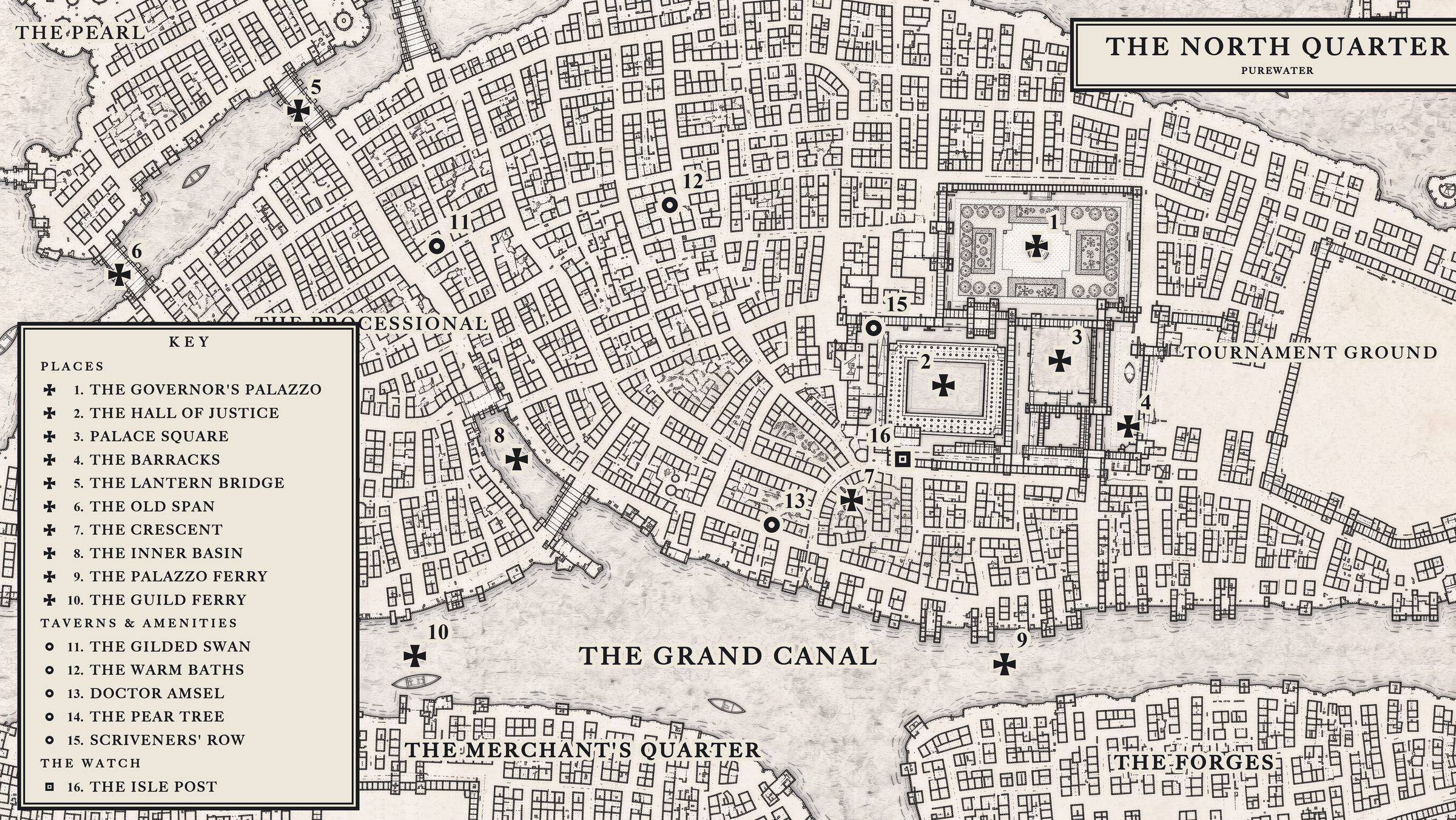
| No. | Name | Kind | Note |
|---|---|---|---|
| 1 | The Governor’s Palazzo | Place | - |
| 2 | The Hall of Justice | Place | - |
| 3 | Palace Square | Place | - |
| 4 | The Barracks | Place | - |
| 5 | The Lantern Bridge | Place | - |
| 6 | The Old Span | Place | - |
| 7 | The Crescent | Place | - |
| 8 | The Inner Basin | Place | - |
| 9 | The Palazzo Ferry | Place | - |
| 10 | The Guild Ferry | Place | - |
| 11 | The Gilded Swan | Tavern or amenity | the respectable inn on the Processional, where competitors’ families stay |
| 12 | The Warm Baths | Tavern or amenity | a public bathhouse, the warmest place on the island, and the most indiscreet |
| 13 | Doctor Amsel | Tavern or amenity | physician by the Crescent, sent for by minor lords for embarrassing things |
| 14 | The Pear Tree | Tavern or amenity | a wine house at the rich west end, where the off-duty watch drink where the dragonshits do not go |
| 15 | Scriveners’ Row | Tavern or amenity | clerks, notaries and copyists under the Hall of Justice’s walls |
| 16 | The Isle Post | Watch post | the watch-house of High Isle, where Captain Sarn commands and Sergeant Abel Weir keeps the four-inch referral book |
The Merchant’s Quarter lies south across the Grand Canal, where the Triumph Bridge brings the caravan trade ashore and the city’s money is made. Its walled Market Square is ringed by the guildhalls of the Merchants, Coopers and Dyers, and the palazzi of the merchant princes who sit on the city council line the canal.
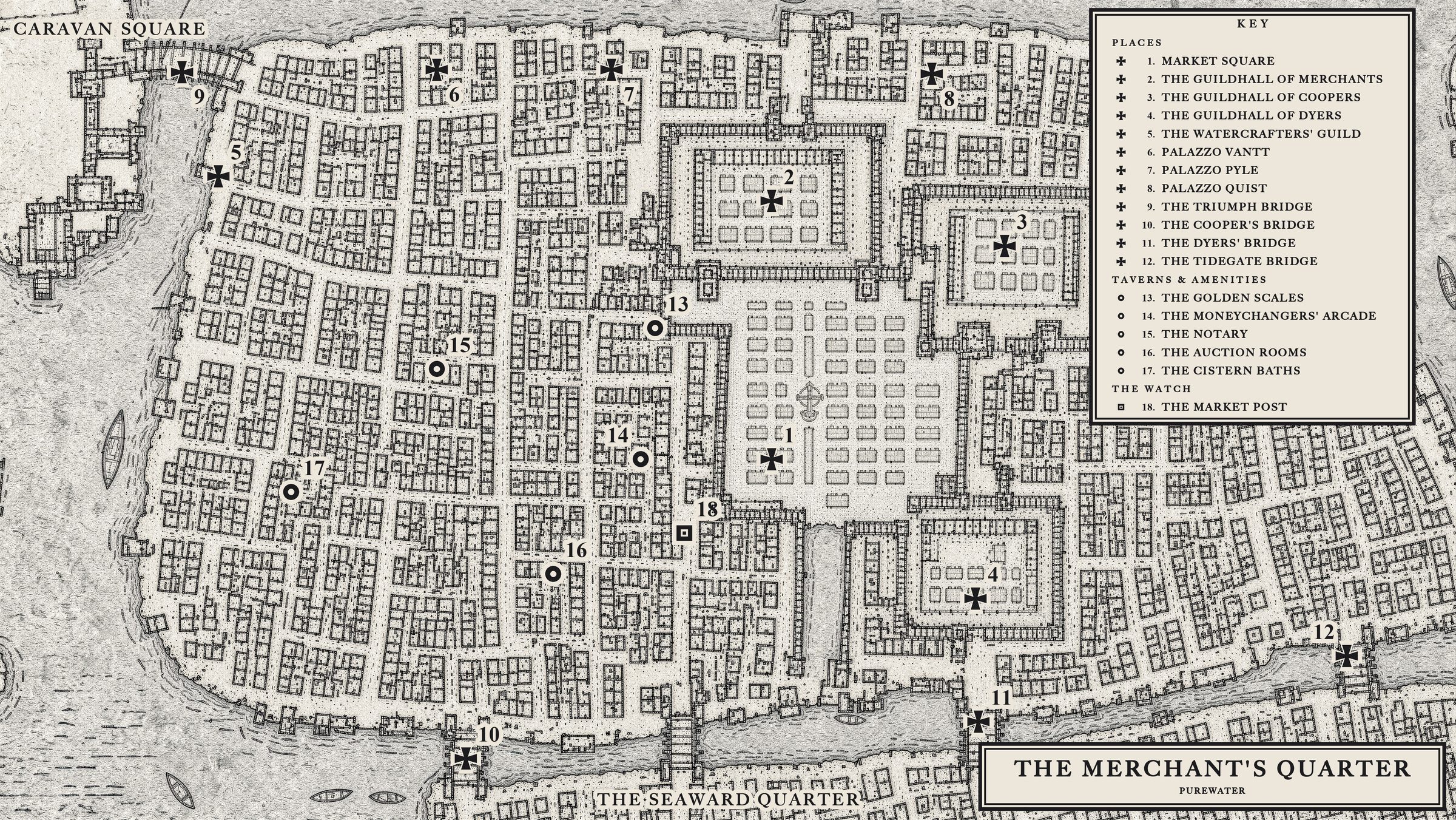
| No. | Name | Kind | Note |
|---|---|---|---|
| 1 | Market Square | Place | - |
| 2 | The Guildhall of Merchants | Place | - |
| 3 | The Guildhall of Coopers | Place | - |
| 4 | The Guildhall of Dyers | Place | - |
| 5 | The Watercrafters’ Guild | Place | - |
| 6 | Palazzo Vantt | Place | - |
| 7 | Palazzo Pyle | Place | - |
| 8 | Palazzo Quist | Place | - |
| 9 | The Triumph Bridge | Place | - |
| 10 | The Cooper’s Bridge | Place | - |
| 11 | The Dyers’ Bridge | Place | - |
| 12 | The Tidegate Bridge | Place | - |
| 13 | The Golden Scales | Tavern or amenity | the factors’ wine house; more business is done at its tables than in the Guildhall |
| 14 | The Moneychangers’ Arcade | Tavern or amenity | under the arcade on the square’s west side; refusing di Teufel credit notes, loudly |
| 15 | The Notary | Tavern or amenity | contracts, deeds and public notices; the notice board outside draws a crowd |
| 16 | The Auction Rooms | Tavern or amenity | a dead man’s stock sold every week, sometimes with his widow present |
| 17 | The Cistern Baths | Tavern or amenity | bathhouse for the clerks and apprentices |
| 18 | The Market Post | Watch post | the watch post on the square, whose patrols now route round the quarter rather than be seen not acting |
The Forges are the industrial island: foundries, boatyards and tanneries, many of them dwarf-run, with the Forge Tower over the south shore and smoke over the water day and night. The Seaward Quarter runs along the south shore behind them, a comb of piers and slips with the round Harbour Master’s Tower at the tip of the longest mole.
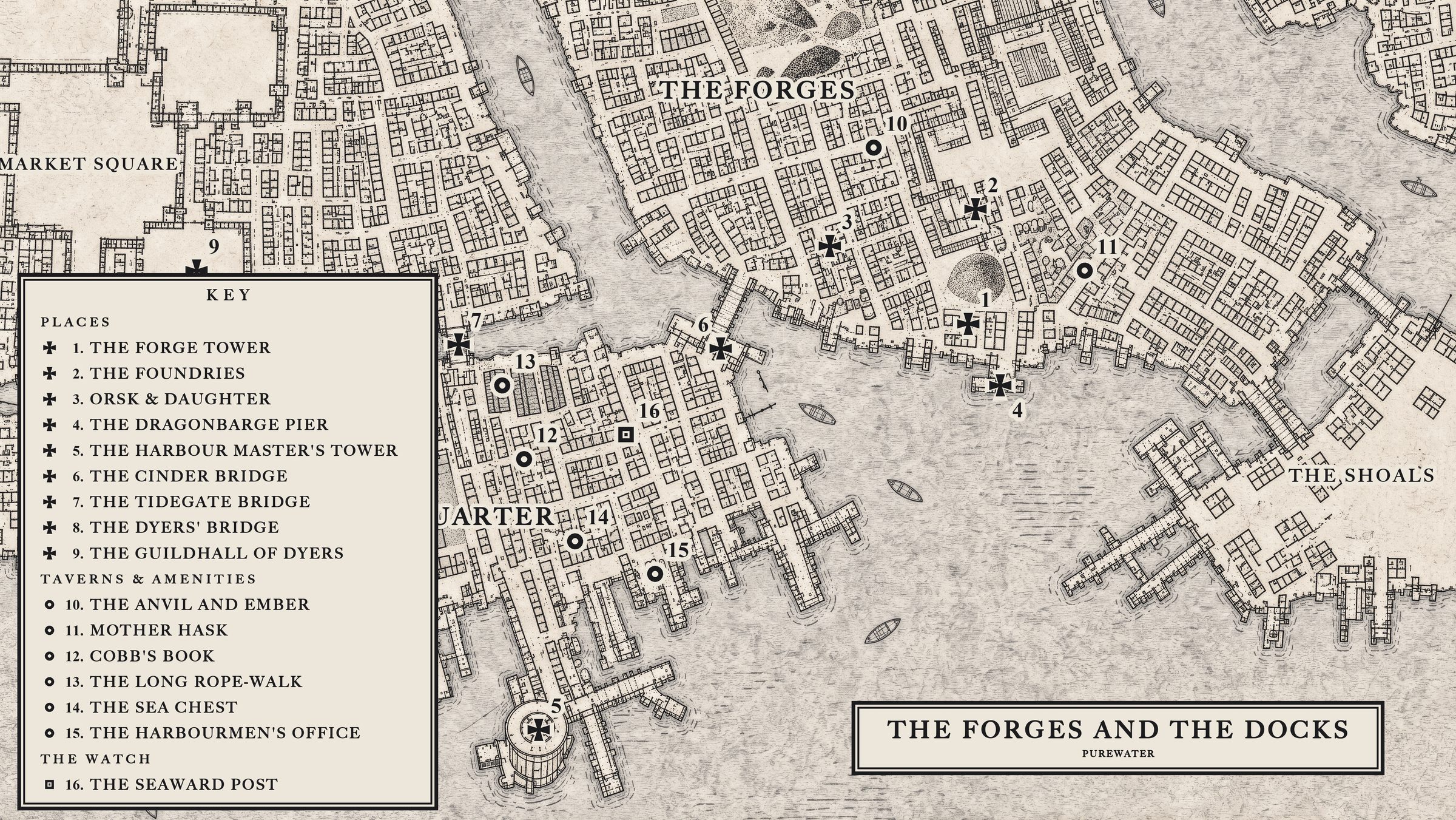
| No. | Name | Kind | Note |
|---|---|---|---|
| 1 | The Forge Tower | Place | - |
| 2 | The Foundries | Place | - |
| 3 | Orsk & Daughter | Place | - |
| 4 | The DragonBarge Pier | Place | - |
| 5 | The Harbour Master’s Tower | Place | - |
| 6 | The Cinder Bridge | Place | - |
| 7 | The Tidegate Bridge | Place | - |
| 8 | The Dyers’ Bridge | Place | - |
| 9 | The Guildhall of Dyers | Place | - |
| 10 | The Anvil and Ember | Tavern or amenity | the smiths’ tavern, where the Forge Quarter decides which work it will refuse |
| 11 | Mother Hask | Tavern or amenity | burns-healer to the yards, the nearest help for a burned apprentice |
| 12 | Cobb’s Book | Tavern or amenity | bookmaker taking odds on the Tourney, very short on the Baron’s champion, and unhappy about it |
| 13 | The Long Rope-Walk | Tavern or amenity | the ropemakers’ sheds, a quarter-mile of walking backwards |
| 14 | The Sea Chest | Tavern or amenity | sailors’ lodging-house; the cheapest bed in the city with a lock on the door |
| 15 | The Harbourmen’s Office | Tavern or amenity | the Harbor Masters’ dockside office, where a berth registration is a public record |
| 16 | The Seaward Post | Watch post | the busiest post in the city, which has quietly stopped sending patrols anywhere near the barge pier |
The Pearl
North of High Isle, among the scattered Northern Isles, lies the Pearl, the pleasure island: lamplit and lovely over dark water, its houses stringing their lamps like pearls along Pearl Quay. The Siren’s Call, the Sylph’s Embrace, the Mother of Pearl, the Lily Garden and the Promise of Heaven are all here, and all of them answer to one woman, the madame Marisette.
Every child on the Pearl can tell you the story of the Widow. Two hundred years ago a merchant prince bought a fifteen-year-old girl outright, with a bill of sale witnessed by two councillors, and kept her behind a wall on a little islet. Every dusk for eleven years she lit a lamp in her window and talked to the water, and one calm night the water took him. With his money she bought the biggest house on the quay, opened its doors to women who had been sold as she had been, and made the rule every house on the island still keeps: a night is for sale; a person is not. No bill of sale for a woman is honoured on the Pearl, and no man who brings one is let in anywhere on the island again.
Every dusk, a doorman carries a flame from the Widow’s lamp down the quay, and every house lights its lamps from it, and then the posts of the Lantern Bridge. The Pearl’s women will tell you that nobody standing under that flame can be owned. Whether that is true is a matter of opinion.
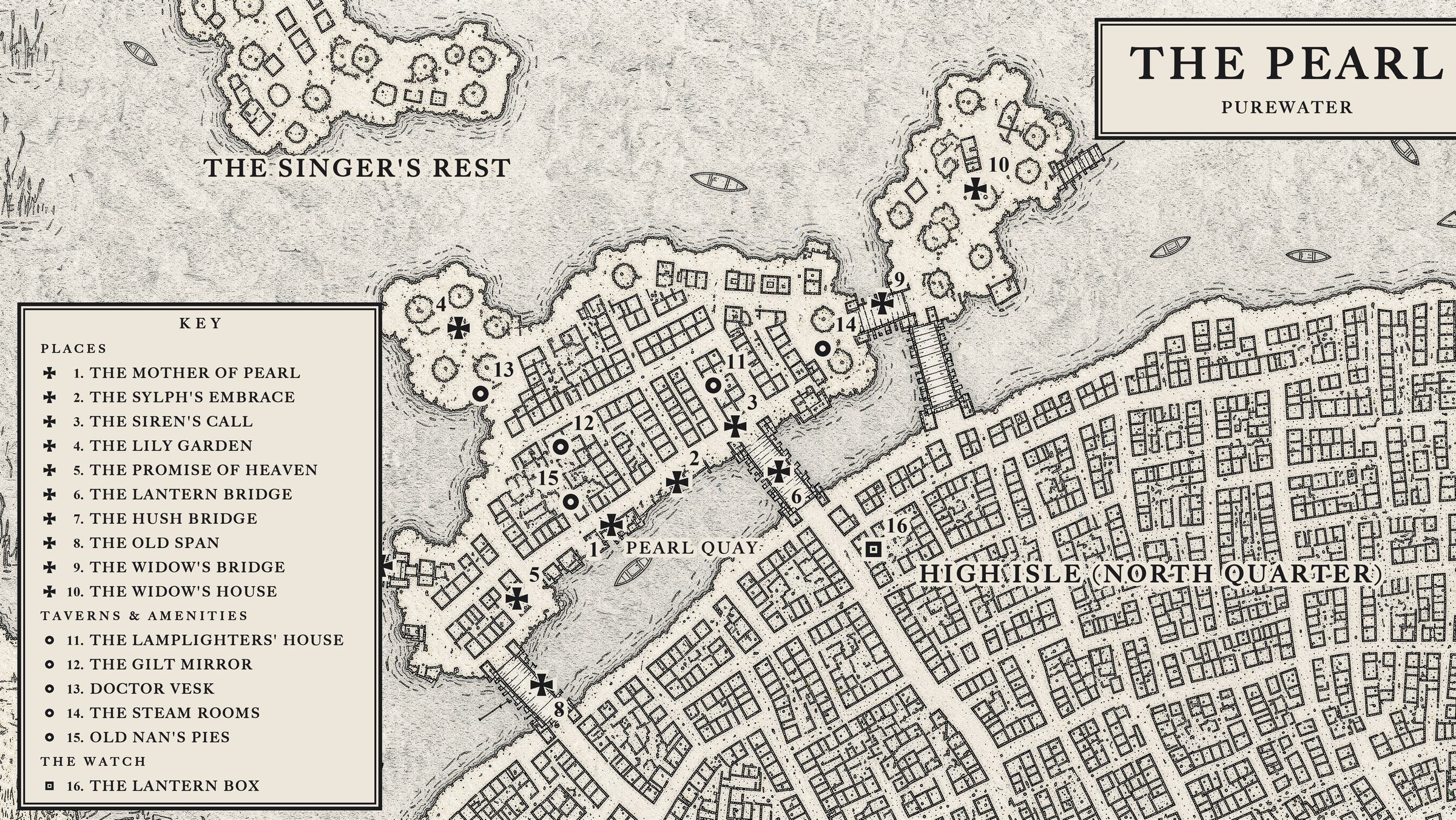
| No. | Name | Kind | Note |
|---|---|---|---|
| 1 | The Mother of Pearl | Place | - |
| 2 | The Sylph’s Embrace | Place | - |
| 3 | The Siren’s Call | Place | - |
| 4 | The Lily Garden | Place | - |
| 5 | The Promise of Heaven | Place | - |
| 6 | The Lantern Bridge | Place | - |
| 7 | The Hush Bridge | Place | - |
| 8 | The Old Span | Place | - |
| 9 | The Widow’s Bridge | Place | - |
| 10 | The Widow’s House | Place | - |
| 11 | The Lamplighters’ House | Tavern or amenity | the men who carry the Widow’s flame along the Quay and over the Lantern Bridge every dusk |
| 12 | The Gilt Mirror | Tavern or amenity | perfumer and wig-maker to the houses; the best gossip on the island, all of it second-hand |
| 13 | Doctor Vesk | Tavern or amenity | a discreet physician who treats the houses’ women for free and their clients for a great deal |
| 14 | The Steam Rooms | Tavern or amenity | a bathhouse, mixed, where nobody uses their real name |
| 15 | Old Nan’s Pies | Tavern or amenity | an eel-pie stall on the Quay; Nan knows the name of every person who passes and says all of them |
| 16 | The Lantern Box | Watch post | a watch box at the North Quarter end of the Lantern Bridge, unmanned after dark; the Pearl keeps its own order |
The Lullwater
Across open water to the north-east, reached by no bridge, lies the city’s poor-and-criminal quarter: the narrowest, most crooked canals in Purewater, and tenements leaning over them until they almost touch. Its name sounds gentle, a lull, a still water, and that is the joke of it. Thieves, dredgers, smugglers and dockhands all live crammed into the same drowned maze. One straight canal, the Gutter, runs down its spine, and at its heart lies the Still, a round pool of dead water with the Moist Oyster tavern on its edge. The watch post here has its door nailed shut.
It is easy to get lost in the Lullwater, and dangerous to look lost.
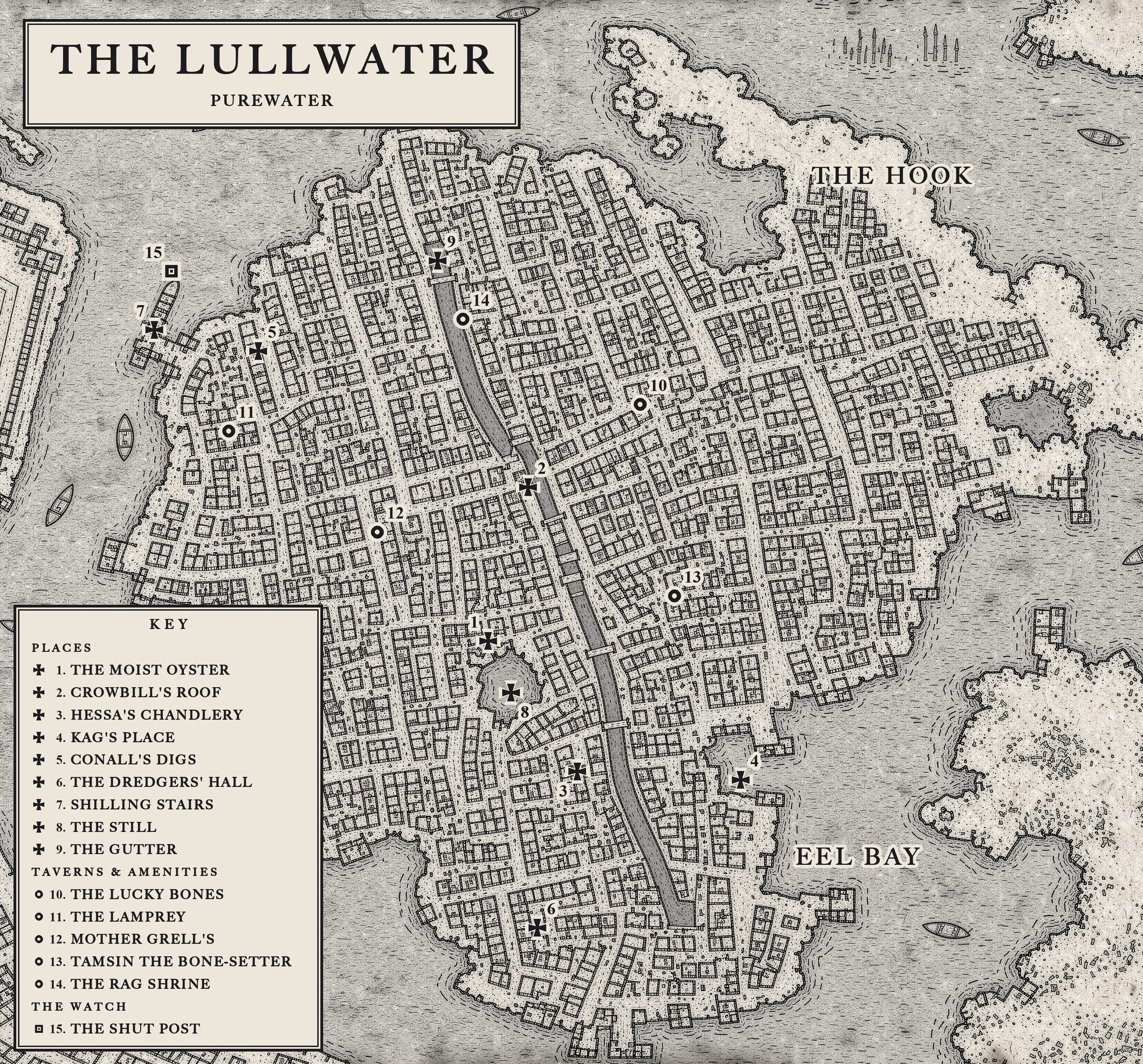
| No. | Name | Kind | Note |
|---|---|---|---|
| 1 | The Moist Oyster | Place | - |
| 2 | Crowbill’s Roof | Place | - |
| 3 | Hessa’s Chandlery | Place | - |
| 4 | Kag’s Place | Place | - |
| 5 | Conall’s Digs | Place | - |
| 6 | The Dredgers’ Hall | Place | - |
| 7 | Shilling Stairs | Place | - |
| 8 | The Still | Place | - |
| 9 | The Gutter | Place | - |
| 10 | The Lucky Bones | Tavern or amenity | Crowbill’s dice den, up a back stair; the house never cheats, because it never needs to |
| 11 | The Lamprey | Tavern or amenity | boatmen’s alehouse at the head of Shilling Stairs; whoever rowed you over is drinking here by the time you leave |
| 12 | Mother Grell’s | Tavern or amenity | pawnbroker; buys anything, asks nothing, remembers everything |
| 13 | Tamsin the Bone-Setter | Tavern or amenity | the only physician who will come to the Lullwater, and she lives in it |
| 14 | The Rag Shrine | Tavern or amenity | a Dredgers’ shrine under the Gutter’s north bridge, hung with strips of cloth for the drowned |
| 15 | The Shut Post | Watch post | a watch post with its door nailed shut; the watch comes over only to fish out the dead |
The Shoals
The seaward jaw of the Mouth: a low, ragged island of fish-markets, wharves, net-lofts, ice-houses and smugglers’ jetties at the city’s south-east corner. The Fishmarket Stair at the foot of the Fishmarket Bridge is the busiest water-stair in the city, and the Low Canals beyond it, four thousand people on plank walkways and stilt-houses, are the poorest. The dock labourers’ guild, the Dredgers, are strongest here.
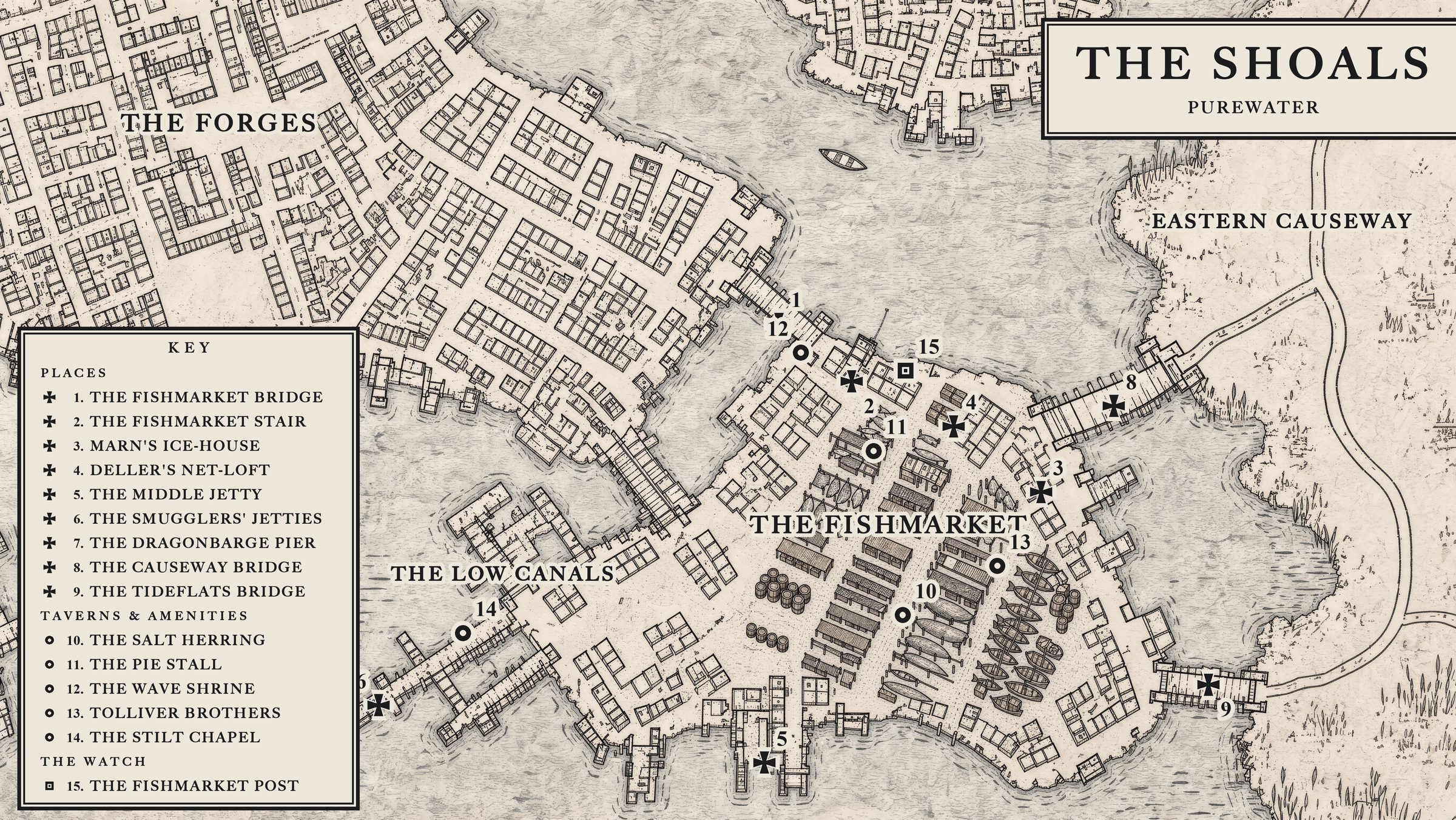
| No. | Name | Kind | Note |
|---|---|---|---|
| 1 | The Fishmarket Bridge | Place | - |
| 2 | The Fishmarket Stair | Place | - |
| 3 | Marn’s Ice-House | Place | - |
| 4 | Deller’s Net-Loft | Place | - |
| 5 | The Middle Jetty | Place | - |
| 6 | The Smugglers’ Jetties | Place | - |
| 7 | The DragonBarge Pier | Place | - |
| 8 | The Causeway Bridge | Place | - |
| 9 | The Tideflats Bridge | Place | - |
| 10 | The Salt Herring | Tavern or amenity | dockside alehouse for the fish-porters and the dredge crews; the Fishmarket sergeant drinks here and writes nothing down |
| 11 | The Pie Stall | Tavern or amenity | eel pies off the market’s first catch, hot from four in the morning |
| 12 | The Wave Shrine | Tavern or amenity | a Dredgers’ shrine under the Fishmarket Bridge, chalked with the white wave |
| 13 | Tolliver Brothers | Tavern or amenity | rope and tar, and the same joke since spring; on Kag’s round |
| 14 | The Stilt Chapel | Tavern or amenity | a chapel of the Lady on stilts in the Low Canals, reached by rope bridge |
| 15 | The Fishmarket Post | Watch post | the watch post on the market; it records, refers, and keeps its shutters half-closed toward the bridge |
The Tournament Ground and Temple Isle
At the east end of the North Quarter stands the walled Tournament Ground: a six-sided list of raked sand ringed by timber stands for four thousand people, with the Governor’s box built into the western stand. The Long Butts, where the archery is shot, run along its north side.
Just north, across a narrow water and in plain sight of the stands, lies Temple Isle: the temple of the Lake Lady and the great round pool of the Sacred Confluence, where the purest lake-water wells up. Its broad water-steps face the Tournament Ground.
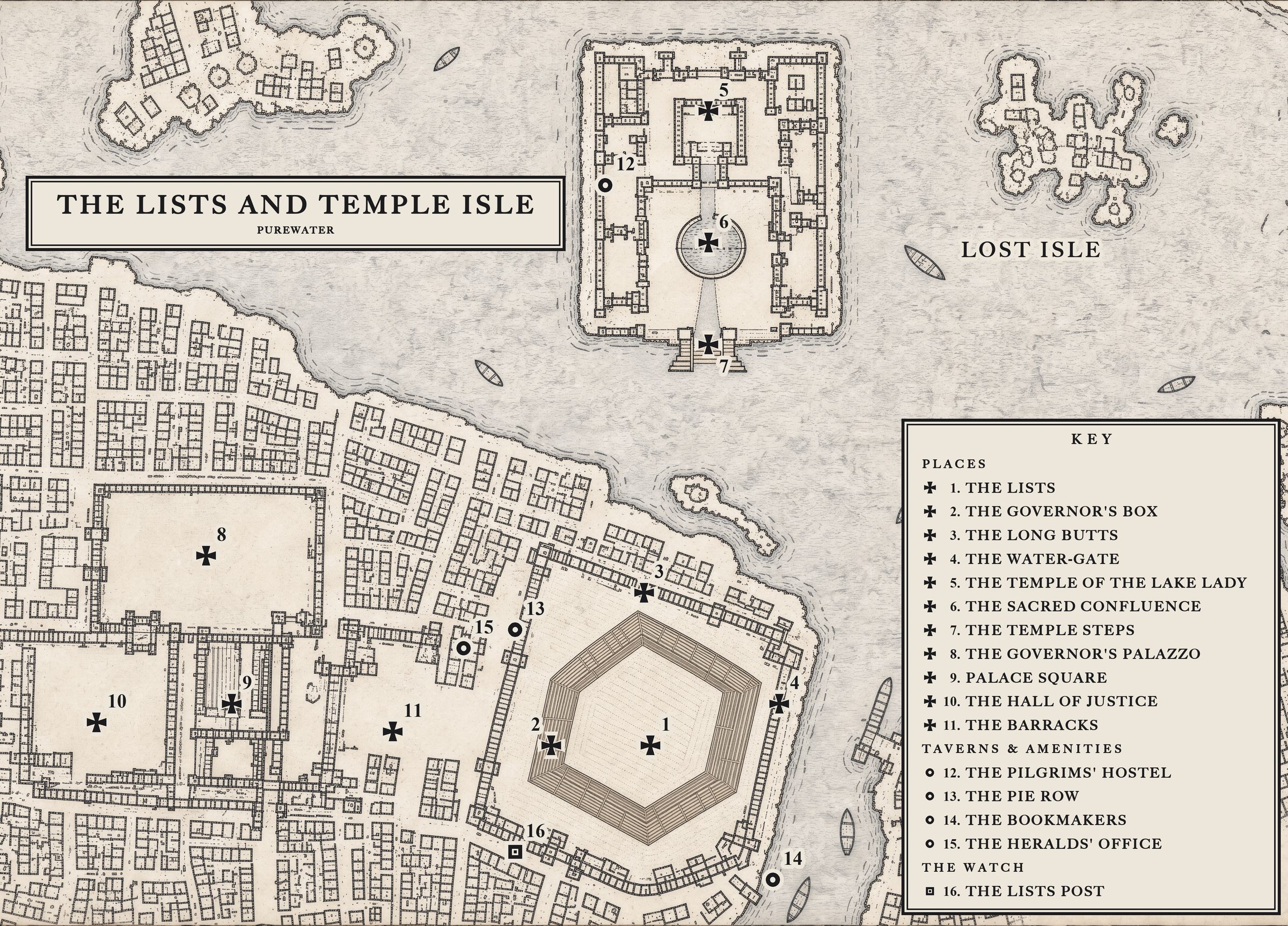
| No. | Name | Kind | Note |
|---|---|---|---|
| 1 | The Lists | Place | - |
| 2 | The Governor’s Box | Place | - |
| 3 | The Long Butts | Place | - |
| 4 | The Water-Gate | Place | - |
| 5 | The Temple of the Lake Lady | Place | - |
| 6 | The Sacred Confluence | Place | - |
| 7 | The Temple Steps | Place | - |
| 8 | The Governor’s Palazzo | Place | - |
| 9 | Palace Square | Place | - |
| 10 | The Hall of Justice | Place | - |
| 11 | The Barracks | Place | - |
| 12 | The Pilgrims’ Hostel | Tavern or amenity | cells in the temple’s west cloister for pilgrims who have walked a long way |
| 13 | The Pie Row | Tavern or amenity | pie and ale stalls along the stands, packed on Tourney days |
| 14 | The Bookmakers | Tavern or amenity | odds chalked on boards outside the east wall; the champion is odds-on and nobody likes it |
| 15 | The Heralds’ Office | Tavern or amenity | the entries, the colours and the order of precedence, argued over in whispers |
| 16 | The Lists Post | Watch post | the Tourney watch post, whose yard the Knights have taken for horse-lines; the watch now works from a hired room |
Caravan Square
The city’s only land approach, on the western shore: staging-yards, warehouses, a beast yard and a wagon park, ending at the Land Gate and the Triumph Bridge. Everybody who comes to Purewater by road comes through here, and most of them stand in it for an hour.
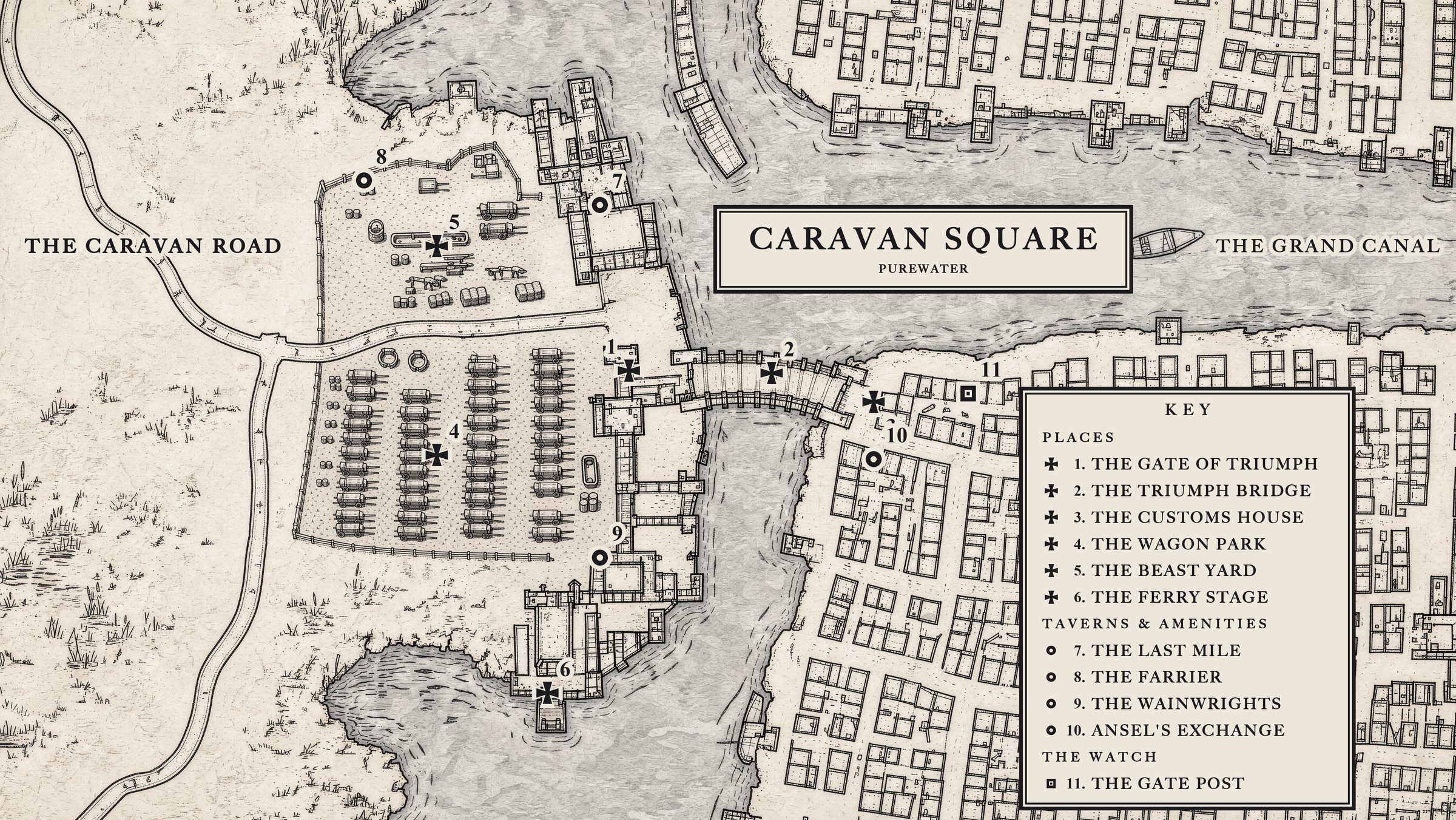
| No. | Name | Kind | Note |
|---|---|---|---|
| 1 | The Gate of Triumph | Place | - |
| 2 | The Triumph Bridge | Place | - |
| 3 | The Customs House | Place | - |
| 4 | The Wagon Park | Place | - |
| 5 | The Beast Yard | Place | - |
| 6 | The Ferry Stage | Place | - |
| 7 | The Last Mile | Tavern or amenity | carters’ inn on the waterfront, the first and last drink of every caravan |
| 8 | The Farrier | Tavern or amenity | shoes the caravan teams in the beast yard, and the Baron’s horses too |
| 9 | The Wainwrights | Tavern or amenity | wagon repair, and a buyer for any wagon that will not be going home |
| 10 | Ansel’s Exchange | Tavern or amenity | moneychanger by the customs house; every coin of the borderland at a rate that changes when he sees you |
| 11 | The Gate Post | Watch post | the watch post at the customs end of the Triumph Bridge, whose watchman does nothing about the three Knights in the middle of it |